Betting Odds Explained
Odds tell you two things: the potential return if a bet wins and the probability implied by the price.
18+ only. Availability depends on your location — confirm licensing before you sign up.
Decimal odds
At decimal odds of 3.00, every £1 staked returns £3 in total if the bet wins. A £10 stake returns £30, including the £10 stake.
Fractional odds
Fractional odds of 5/2 mean £5 potential profit for every £2 staked. A £10 stake at 5/2 therefore produces £25 profit plus the £10 stake, for £35 total return.
Implied probability
Decimal odds of 2.00 imply 50%; 4.00 implies 25%. This is a mathematical conversion of the price, not proof of the true chance of the event.
Why probabilities can add above 100%
Bookmakers build a margin into a market. If you convert every selection's odds to implied probability and add them together, the total can exceed 100%. That excess is one way to see the market margin.
Converting between formats
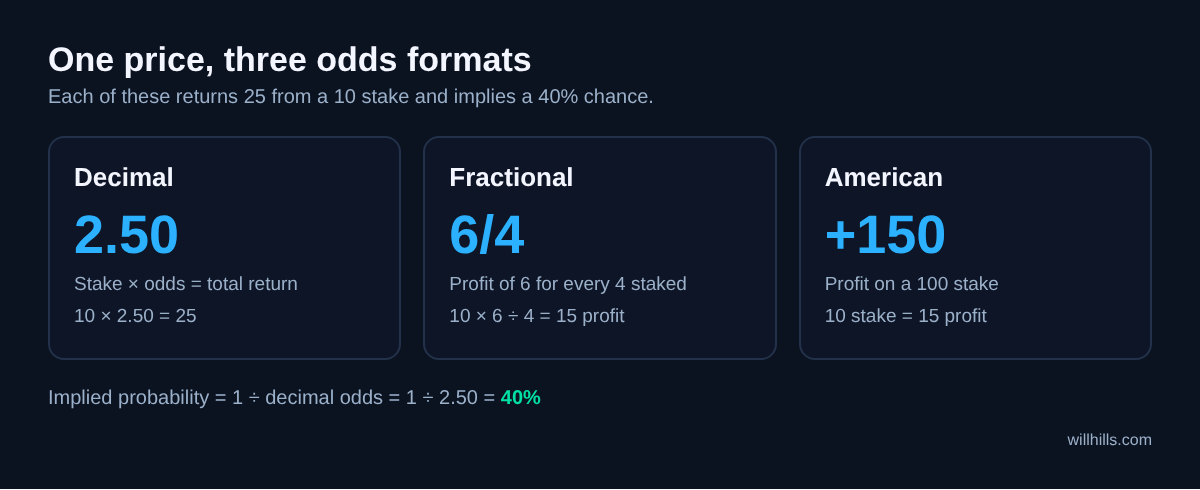
The same price can be shown three ways:
- Fractional to decimal: divide, then add 1. 5/2 = 2.5 + 1 = 3.50. 4/6 = 0.667 + 1 = 1.67.
- Decimal to fractional: subtract 1, then turn it into a fraction. 1.80 − 1 = 0.80 = 4/5.
- American (moneyline): positive numbers show profit on a 100 stake (+250 = 3.50 decimal); negative numbers show what you'd stake to win 100 (−150 = 1.67 decimal).
Most UK sites let you switch format in account settings. Decimal is the easiest for comparing prices and working out multiples.
"Evens", "odds-on" and "odds-against"
Evens (1/1, 2.00) returns double your stake. Odds-on means shorter than evens, such as 1/2 (1.50), where you risk more than you stand to win. Odds-against is longer than evens, such as 3/1 (4.00). Odds-on doesn't mean "safe". A 1/2 shot is still expected to lose about a third of the time.
Finding the margin in a market
Take a football match priced Home 2.10, Draw 3.40, Away 3.60. The implied probabilities are 47.6%, 29.4% and 27.8%, which add up to 104.8%. The extra 4.8% is the bookmaker's margin (sometimes called the overround). Two things follow:
- To work out a "fair" probability, divide each figure by the total: the home win's 47.6% becomes about 45.4%.
- Comparing the overround between bookmakers on the same match shows which is pricing more generously.
Margins are usually smaller on major markets, such as the match result in top leagues, and bigger on niche or multi-outcome markets like correct score or first goalscorer.
Why odds move
Prices shift with team news, weather, the weight of money and bookmakers' own models. A price that shortens before kick-off shows the market moving towards that outcome. That doesn't mean the earlier price was a mistake. "Best odds guaranteed" offers on racing pay the better of your price or the starting price, so check whether they're available before you bet early.
Odds aren't a forecast you can beat by feel
Odds are the market's best guess plus a margin. To profit over time you'd need to find prices that are wrong more often than the margin costs you, and keep doing it. Very few people manage that. For most, odds are useful for understanding what a bet costs, not for beating the market.
Converting between formats
The three formats all describe the same thing, so it's worth being able to move between them:
- Fractional to decimal: divide the first number by the second and add 1. 5/2 becomes 2.5 + 1 = 3.50.
- Decimal to fractional: subtract 1 and turn what's left into a fraction. 1.80 becomes 0.80, which is 4/5.
- Decimal to implied chance: divide 1 by the odds. 4.00 means 1 ÷ 4 = 25%.
- American odds: +200 means a £100 stake wins £200 profit (decimal 3.00); −200 means you stake £200 to win £100 (decimal 1.50).
Spotting the margin
Add up the implied chances of every outcome in a market. In a fair market they'd total 100%. In practice a football match result market might come to around 105% or more, and the amount over 100% is the bookmaker's margin, often called the overround. The bigger it is, the worse the prices for you. Comparing the total across bookmakers is a quick way to see who's offering better value on the same event, without needing any view on who will win.
Remember that odds only tell you the price, not the probability. A bookmaker's price reflects its own estimate, its margin and where other customers' money is going, so a long price isn't automatically good value.
Operator rules and market terms vary. Always read the bookmaker's current event and settlement rules before betting.
Related guides
Jackpot City’s separate UK site. Check the UK Gambling Commission licence in its footer before you join.