Sports Betting Basics: Odds, Parlays & Bankroll
Understand moneylines, spreads, totals, and parlays in minutes. Then place your first bet at a trusted book.
Reading odds
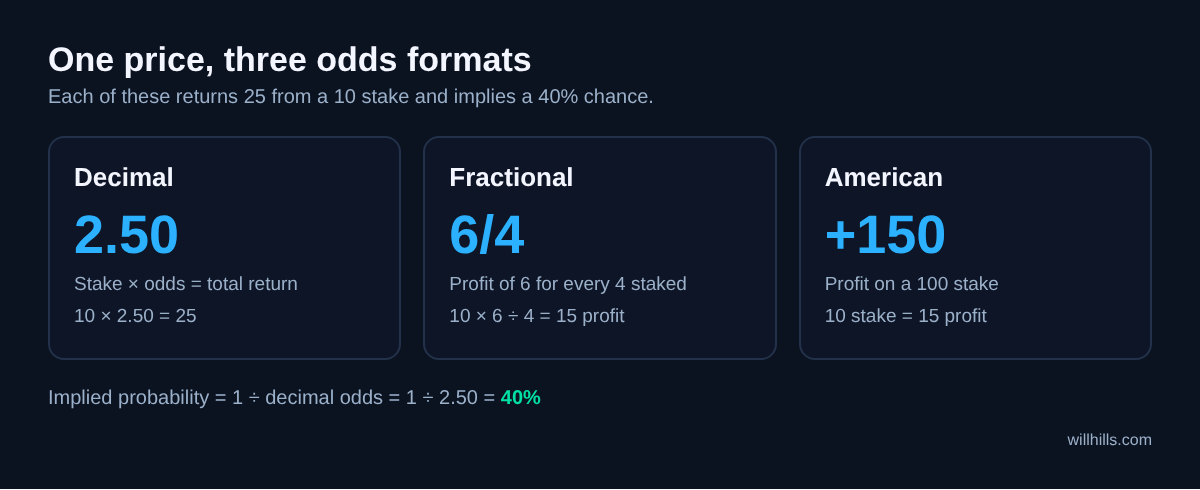
Odds tell you two things: how much a bet pays and how likely the bookmaker thinks the outcome is. The same price can be written three ways.
| Format | Example | A 10 stake returns | Where it is common |
|---|---|---|---|
| Decimal | 2.50 | 25 (15 profit) | Europe, Canada, Australia |
| Fractional | 6/4 | 25 (15 profit) | UK and Ireland |
| American (moneyline) | +150 | 25 (15 profit) | United States |
To turn decimal odds into an implied probability, divide 1 by the odds. Odds of 2.50 imply a 40% chance.
Common bet types
| Bet | What you are betting on |
|---|---|
| Match result (moneyline) | Which side wins |
| Handicap (spread) | A side to win after a points or goals head start is applied |
| Totals (over/under) | Whether the combined score is above or below a set number |
| Accumulator (parlay) | Several selections that must all win; the odds multiply |
| Prop | An event within the match, such as a player to score |
| Futures (outright) | A longer-term result, such as a league winner |
The bookmaker's margin
If you add up the implied probabilities of every outcome in a market, the total comes to more than 100%. The extra is the bookmaker's margin, and it is how the bookmaker expects to profit whatever the result. Accumulators multiply that margin with each added selection, which is why they pay well and rarely win.
Managing a betting budget
- Set aside an amount you can afford to lose and treat it as spent.
- Keep each stake to a small, fixed share of that amount.
- Do not raise stakes to recover a loss.
- Keep a record of your bets. Most people overestimate how they are doing.
Before you place a bet
- Check the bookmaker is licensed where you live.
- Read the settlement rules for the sport: extra time, abandoned matches and void bets are handled differently.
- Compare prices. The same bet often pays more elsewhere.