Roulette Guide: European vs. American & Common Bets
Understand roulette wheels, inside/outside bets, and simple approaches for beginners.
How a round works
You place chips on the layout, the wheel spins, and the ball lands in one numbered pocket. Bets that include that number win and the rest lose. Every spin is independent of the last.
European, French and American wheels
| Wheel | Pockets | House edge |
|---|---|---|
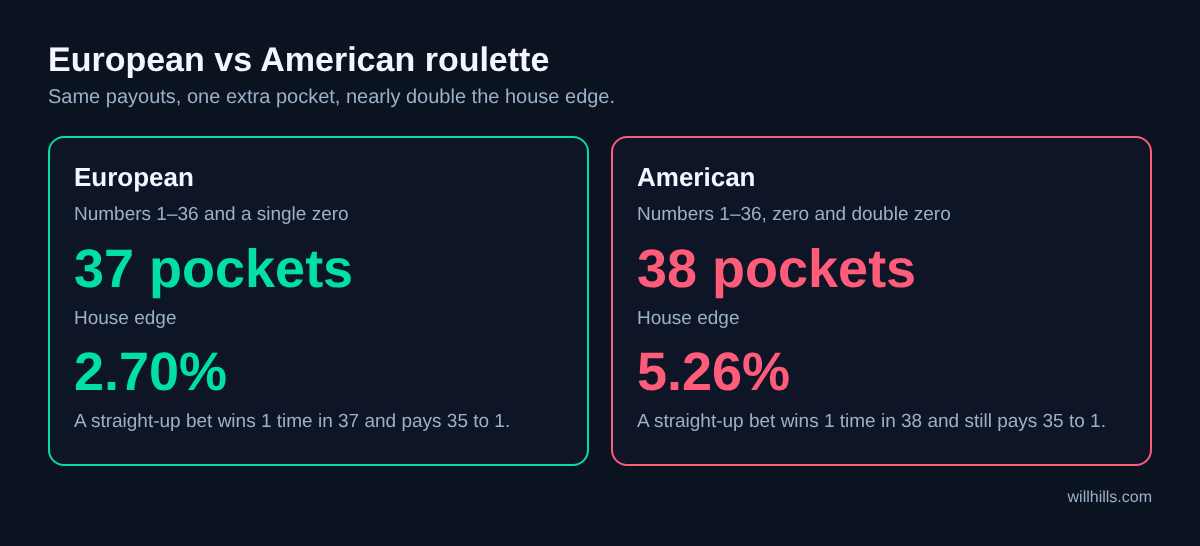
| European | 37: numbers 1–36 and a single zero | 2.70% |
| French | 37, with the la partage rule on even-money bets | 1.35% on even-money bets |
| American | 38: numbers 1–36, zero and double zero | 5.26% |
The payouts are the same on every wheel, so the extra zero on an American wheel only makes each bet worse. If you have the choice, pick a single-zero wheel.
Bets and payouts
| Bet | Covers | Pays | Chance to win (European) |
|---|---|---|---|
| Straight up | 1 number | 35 to 1 | 2.70% |
| Split | 2 numbers | 17 to 1 | 5.41% |
| Street | 3 numbers | 11 to 1 | 8.11% |
| Corner | 4 numbers | 8 to 1 | 10.81% |
| Six line | 6 numbers | 5 to 1 | 16.22% |
| Dozen or column | 12 numbers | 2 to 1 | 32.43% |
| Red/black, odd/even, high/low | 18 numbers | 1 to 1 | 48.65% |
Inside bets (on the numbers) pay more and win less often. Outside bets (on colours, dozens and so on) win more often and pay less. The house edge is the same on all of them.
Betting systems
Systems such as the Martingale, where you double your stake after each loss, change how your wins and losses are spread out. They do not change the house edge, and a long losing run can hit the table limit or empty your balance quickly.
Before you play
- Check which wheel the table uses.
- Check the minimum and maximum bets.
- Decide your budget for the session before the first spin.